
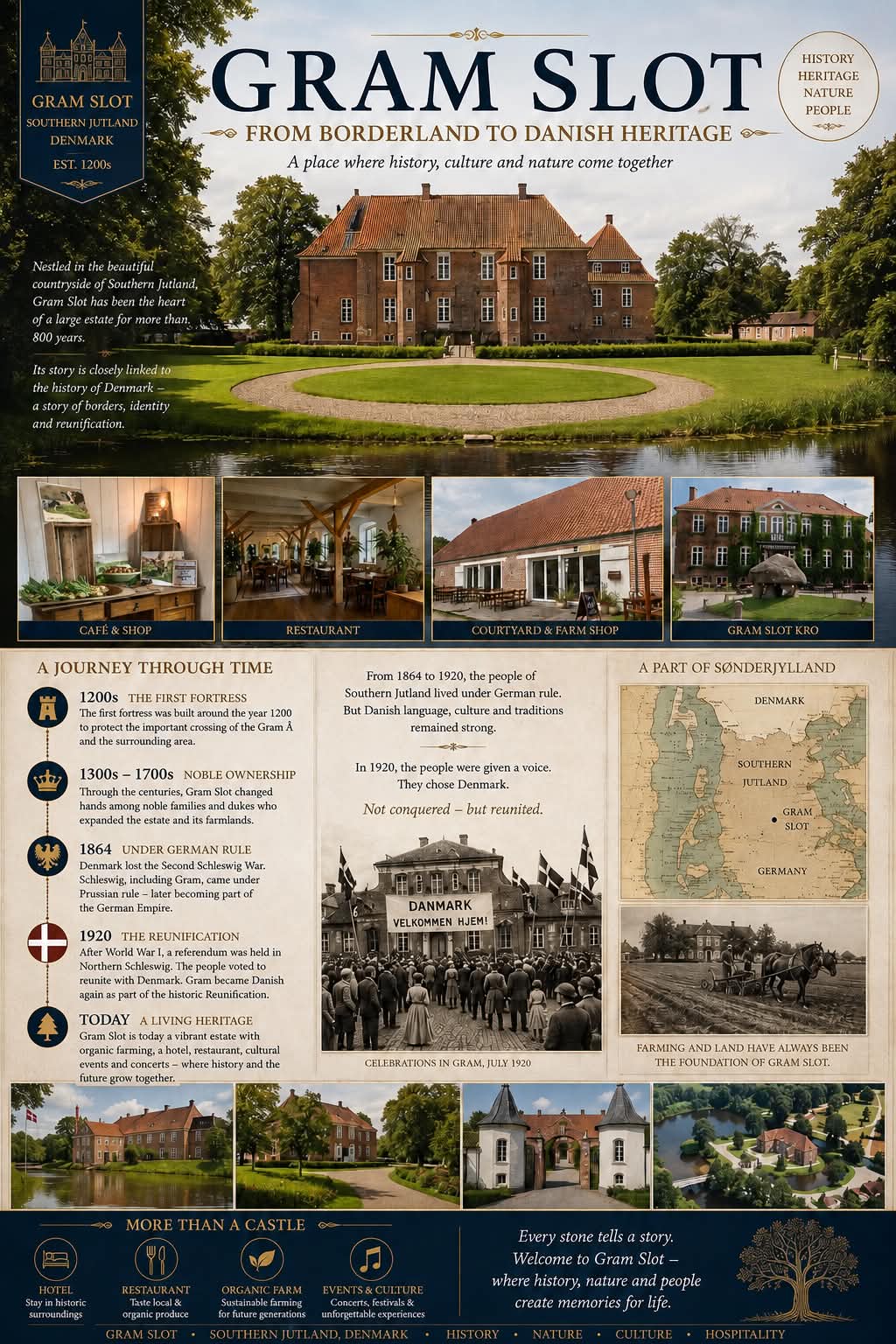
GRAM CASTLE

Gram Castle – A Place Where History Changed the Border
Nestled in the beautiful countryside of Southern Jutland, Gram Castle is far more than a magnificent historic estate. It stands as a silent witness to centuries of Danish history, political change, and one of the most significant events in the nation’s past.
The first fortress on the site dates back to the 13th century, built to protect this strategically important region. Over the centuries, the castle passed through the hands of noble families and dukes, each leaving their mark on its rich heritage.
One of the most dramatic chapters began in 1864, when Denmark lost the Second Schleswig War. As a result, the entire region of Schleswig—including Gram—became part of Prussia, and later the German Empire. For more than fifty years, the people of the area lived under German administration, while preserving strong Danish traditions and culture.
Everything changed after the First World War.
In 1920, the people of Northern Schleswig were given the opportunity to decide their own future through a historic referendum. The majority voted to reunite with Denmark, leading to the famous Reunification of 1920. Gram once again became Danish—not through war, but through the democratic voice of its people.
Today, Gram Castle beautifully combines its remarkable past with modern life. Surrounded by peaceful lakes, forests, and rolling countryside, the castle is known for its organic farming, cultural events, concerts, and warm hospitality. Every stone, every room, and every corner tells a story of resilience, identity, and the enduring connection between Denmark and Southern Jutland.
Visiting Gram Castle is not only a journey through history—it is an opportunity to experience a place where borders changed, cultures met, and the past continues to inspire the future.